

UNMISS Patrol Ambushed in Jonglei, Killing Two Ethiopian Peacekeepers
25 August 2026 | Jonglei State, South Sudan
(Ethiopian peacekeepers serving with the United Nations Mission in South Sudan (UNMISS). File photo: UNMISS.
Two Ethiopian peacekeepers serving with the United Nations Mission in South Sudan (UNMISS) were killed on 24 August when a UN patrol was ambushed while travelling towards Pajut in Duk County, Jonglei State.
Seven other people were injured, including three Ethiopian peacekeepers, two South Sudan National Police Service personnel and two UN civilian staff.
The attack has drawn condemnation from UNMISS, the United States, United Kingdom and European diplomatic missions in Juba, as well as South Sudanese civil society. It comes less than a week after the UN's Humanitarian Coordinator warned of the growing risks facing humanitarian personnel and operations across South Sudan.
What happened?
The UNMISS patrol was travelling from Bor towards Pajut when it came under attack by unidentified armed individuals.
Information available following the incident placed the attack in the Ajoh-Lou area of Jalle Payam, along the route north from Bor towards Duk County.
Following the attack, UNMISS deployed a Quick Reaction Force to secure the area and support the emergency response. Three casualties were evacuated to the Level II Hospital in Juba and four to the Level II Hospital in Bor for medical treatment. One peacekeeper and one international civilian staff member were subsequently transferred from Juba to Entebbe.
UNMISS confirmed that two peacekeepers were killed and seven people wounded. The two peacekeepers killed, along with the three injured peacekeepers, were Ethiopian.
At the time of writing, responsibility for the attack has not been established. UNMISS has described those responsible as unidentified armed individuals
UNMISS condemns the attack
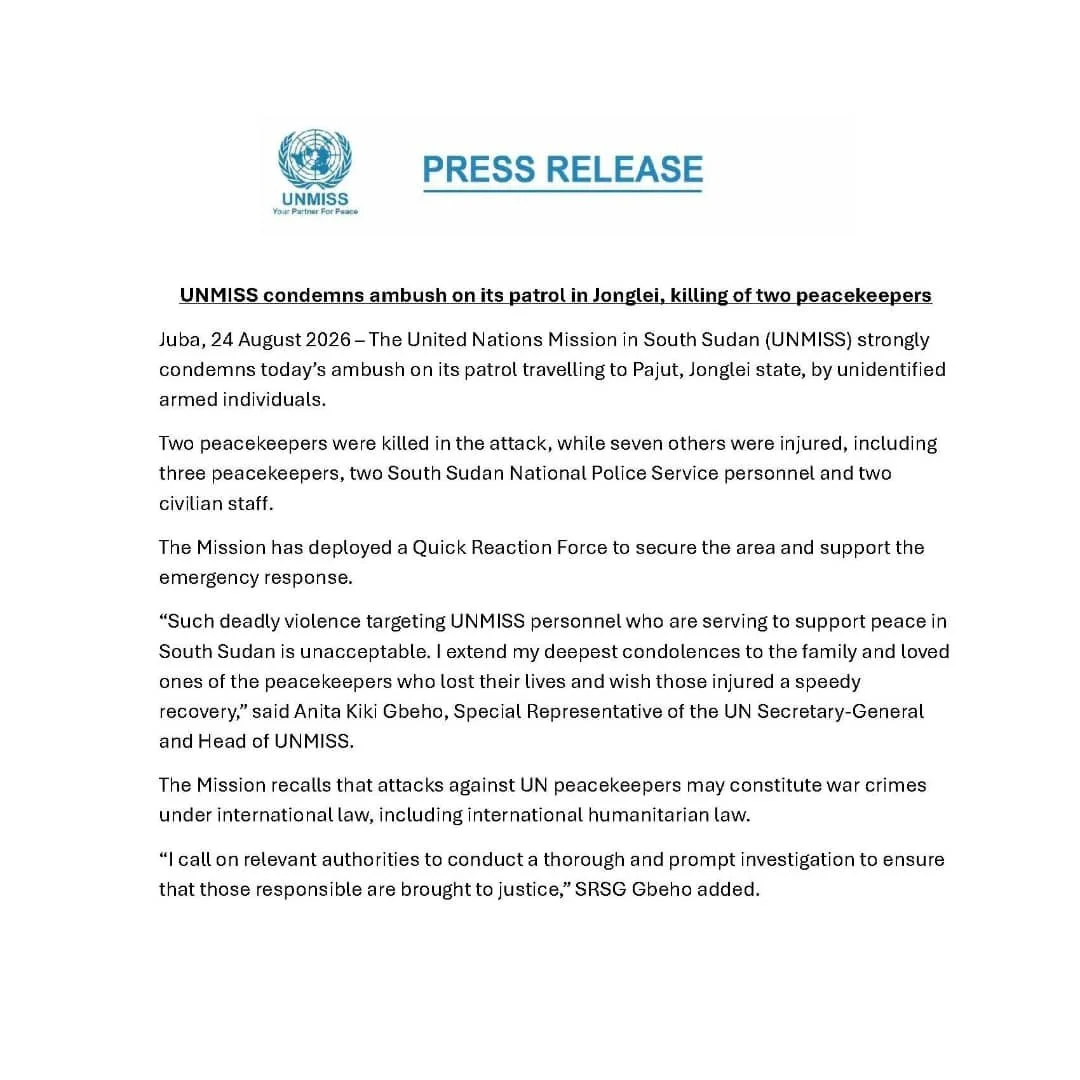
Anita Kiki Gbeho, Special Representative of the UN Secretary-General and Head of UNMISS, strongly condemned the ambush, describing deadly violence against personnel serving in support of peace in South Sudan as unacceptable.
Gbeho expressed condolences to the families and loved ones of the peacekeepers killed and called on the relevant authorities to conduct a thorough and prompt investigation to ensure those responsible are brought to justice.
UNMISS also recalled that attacks against United Nations peacekeepers may constitute war crimes under international law, including international humanitarian law.
The deaths are significant for a Mission whose personnel routinely travel considerable distances across South Sudan, including through remote areas where road conditions, communications and localised insecurity can make movement difficult.
International reaction
The killing of the two Ethiopian peacekeepers prompted a series of statements from diplomatic missions in Juba.
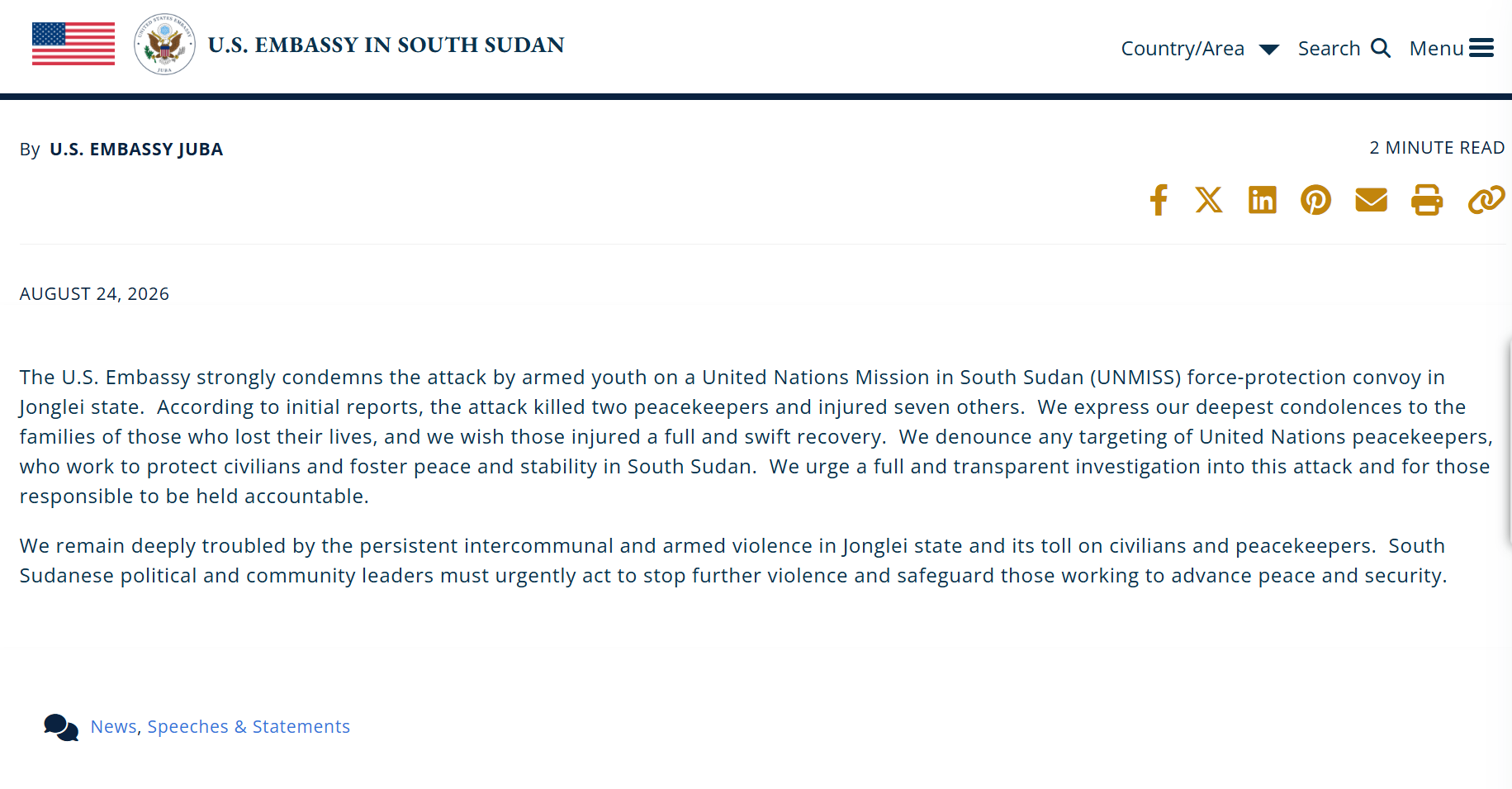
The U.S. Embassy in Juba strongly condemned the attack, expressed condolences to the families of those killed and called for a full and transparent investigation. It also raised concern over continuing intercommunal and armed violence in Jonglei State and called on political and community leaders to act to prevent further violence.
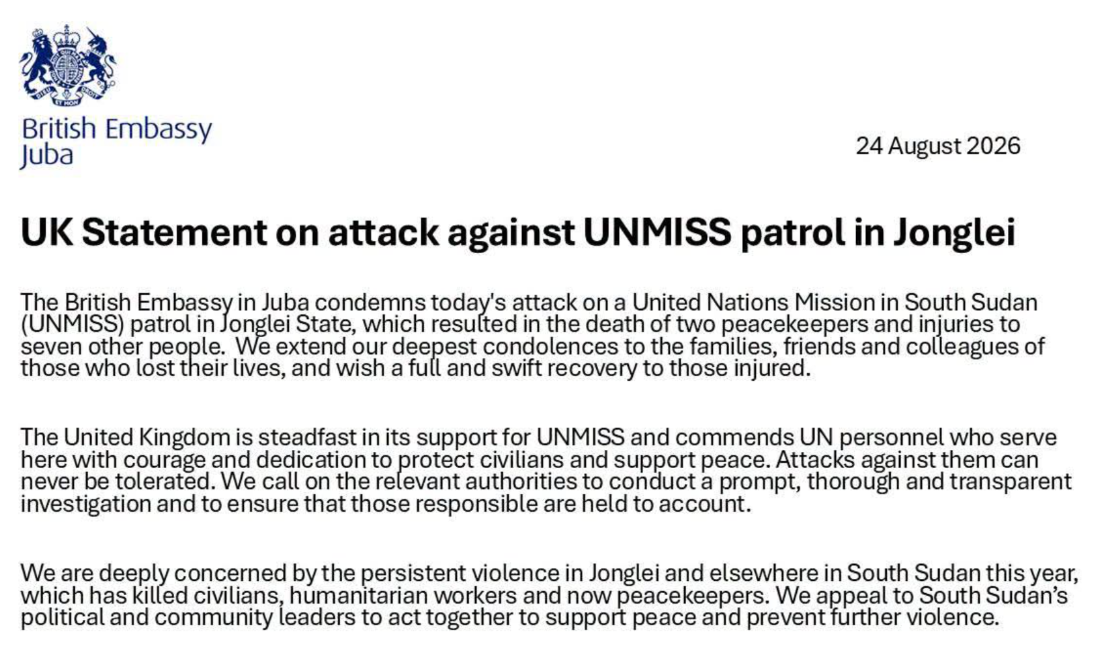
The British Embassy in Juba separately condemned the attack and reaffirmed the UK's support for UNMISS, paying tribute to UN personnel serving in South Sudan. It called for a prompt, thorough and transparent investigation and for those responsible to be held accountable.
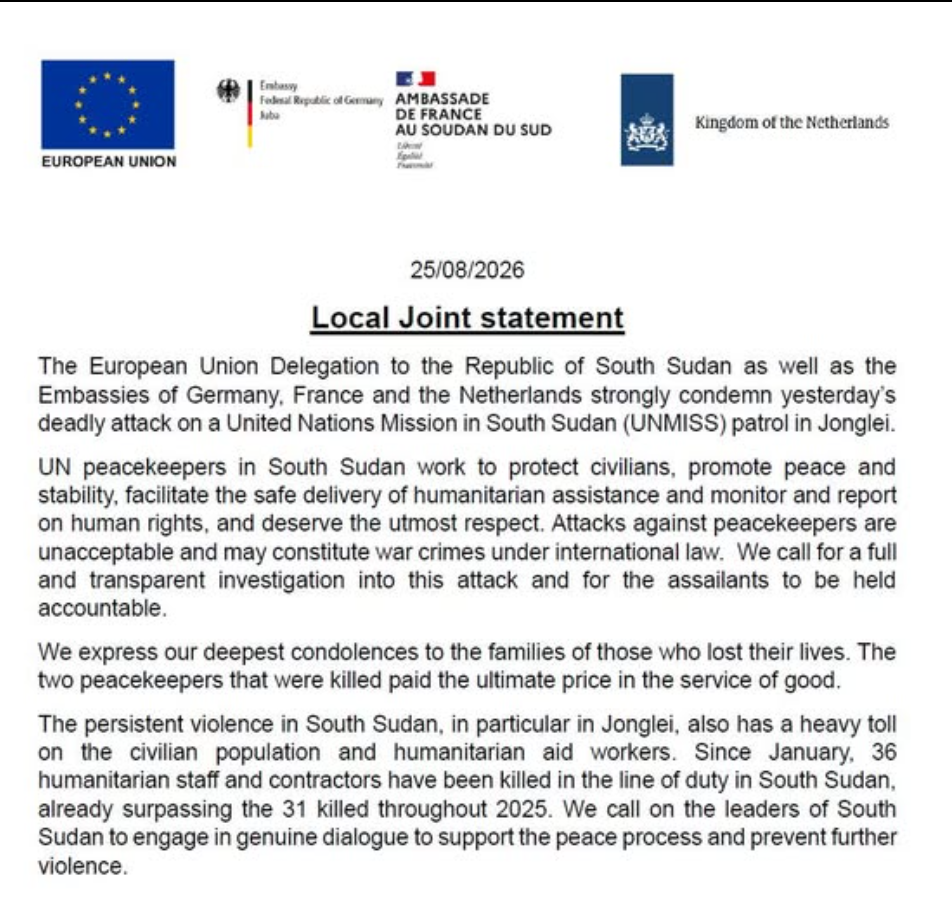
On 25 August, the European Union Delegation to South Sudan and the Embassies of Germany, France and the Netherlands issued a joint statement condemning the attack.
The European missions highlighted the role played by UN peacekeepers in protecting civilians, supporting peace and stability, facilitating the delivery of humanitarian assistance and monitoring human rights. They also called for a full and transparent investigation and for those responsible to be held accountable.
Their statement placed the attack within the wider impact of violence in South Sudan, particularly in Jonglei, and referred to the growing number of humanitarian personnel killed in the country during 2026.
The EU, Germany, France and the Netherlands also called on South Sudan's leaders to engage in dialogue in support of the peace process and to prevent further violence.
South Sudanese civil society joins calls for action
The response has not been limited to international partners.
On 25 August, South Sudan's National Civil Society Coalition condemned the ambush and expressed condolences to the families of those killed and those injured.
The Coalition called for improved security for travellers, residents and humanitarian organisations at the sub-national level, as well as a prompt investigation into the attack and for those responsible to be brought to justice.
Its statement reflects a wider concern familiar to many people travelling outside South Sudan's principal towns: conditions can change considerably between urban centres and the roads connecting them.
Why the attack matters
Ambushes and other security incidents on roads in Jonglei are not new. Routes connecting Bor with communities further north have experienced a number of incidents, and UN road movements have also been targeted previously.
In February 2024, armed men attacked a humanitarian convoy under UNMISS protection approximately 60 kilometres from Bor. A UNMISS vehicle was damaged, but there were no casualties. UNMISS personnel have also faced other attacks and ambushes during road movements elsewhere in Jonglei.
What distinguishes the 24 August attack is its outcome.
Fatal attacks against UN peacekeepers remain relatively rare in South Sudan. The killing of two Ethiopian peacekeepers therefore represents a serious incident for UNMISS and highlights the risks faced during movements through remote areas where armed actors may be present.
It is also important to distinguish insecurity along particular road corridors from conditions across Jonglei as a whole.
Bor remains an important state capital and operational and commercial centre. The security picture outside the town, however, can differ considerably between routes and locations. This distinction is particularly important in Jonglei, where distances are considerable and communities, humanitarian operations and commercial activity rely heavily on a limited number of transport corridors.
The attack therefore draws attention to a longstanding challenge in South Sudan: maintaining safe and reliable movement between population centres across a vast country where road infrastructure is limited and localised insecurity can quickly affect access.
A wider concern around humanitarian access
The timing of the attack is particularly notable.
Just five days earlier, on World Humanitarian Day, 19 August, South Sudan's Humanitarian Coordinator, Ramanathan Balakrishnan, highlighted the increasing risks faced by humanitarian personnel in the country.
According to the UN, 36 humanitarian staff and contractors have been killed in the line of duty in South Sudan since January 2026, already surpassing the 31 killed throughout 2025. The majority of those killed were South Sudanese nationals.
More than 450 incidents of violence affecting humanitarian workers and assets were recorded between January and July 2026, more than double the number recorded during the same period in 2025.
The Humanitarian Coordinator called for humanitarian personnel, civilians and assets to be protected, attacks to be investigated and those responsible held accountable. He also stressed the importance of safe, sustained and principled humanitarian access to communities in need.
The same figures were referenced by the EU, Germany, France and the Netherlands in their joint response to the UNMISS attack on 25 August.
The ambush on the UNMISS patrol is separate from those humanitarian incidents. Peacekeepers are not humanitarian workers and UNMISS operates under a distinct mandate. But both point to a common challenge: ensuring that people working across South Sudan can move safely and reach communities beyond the country's main towns.
For South Sudan, where geography, seasonal conditions and limited infrastructure already make access difficult, insecurity on key roads can have consequences far beyond the location of an individual incident.
The deaths of two Ethiopian peacekeepers on 24 August have therefore attracted attention not only because UN personnel were killed, but because the attack comes amid a broader concern over the security of road movement, humanitarian access and those working to support communities across the countr